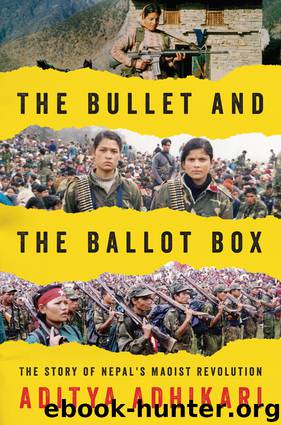
The Bullet and the Ballot Box by Aditya Adhikari
Author:Aditya Adhikari
Language: eng
Format: epub
Publisher: Verso Books
At the Mercy of the People
On the night of 18 March, 2004, Ganga Bahadur Lama came to Chhailung VDC in Lamjung district as political commissar of a group of twenty-two Maoist cadres. In their campaign to mobilize support for the party, the militants had been travelling round the villages, painting slogans and putting up posters, informing locals about the party’s policies and ideology and warning them about the consequences of acting against the Maoists.75
Lamjung is in the Gandaki region, a hill area just west of the Bagmati region, where Kathmandu lies. The region has historically benefited from its proximity to the capital. There are more roads here, for example, than in the districts further west. It was therefore harder for the Maoists to consolidate their rule here than in a far-flung and neglected district like Rolpa. While they had managed to establish party committees and people’s governments across the Gandaki region, they had not been able to totally eliminate the state’s presence. It was not always wise for the rebels to travel openly, or to remain for too long in one place.
Before coming to Lamjung, Ganga Bahadur Lama and his team had travelled through the villages of the adjacent district of Gorkha spreading the party’s message. As there was a large group of soldiers patrolling one of the villages, the rebels were forced to lie low in a forest cave for five days. Having finished whatever rations they were carrying on the first day, they had to scrounge for food. On one occasion they collected nettles from the jungle, which they boiled and ate; on another they managed to procure some rice and goat meat from a house on the periphery of the village. But most of the time they went without. Ganga Bahadur Lama recalls in his memoir how these young Maoists, maddened by boredom and hunger, ‘passed the time by crying one moment and laughing the next, screaming one moment and singing the next.’ When the army finally left, the Maoists climbed down to the village and built a gate there, as a ‘symbol of victory.’76
The rebels had even more reason to be cautious while travelling through Lamjung district. Their comrades in the local party committee had informed them that the Royal Nepal Army could easily get from the district capital to the remotest corners of the district in less than four hours. Moreover, at that time a battalion of the People’s Liberation Army that was usually stationed in a village in Lamjung had gone west to participate in the aforementioned attack on Beni. This meant the proselytisers lacked even a military force to protect them.
Nor were the people of Lamjung particularly sympathetic towards the Maoists. The inhabitants of Chhailung were predominantly Gurung, an ethnic group that refer to themselves as the Tamu. In Lama’s estimate, there were between fifty and sixty Gurung households in the village. The Maoists had promised that once they took over state power, they would transform the Gandaki Region into the Tamuwan Autonomous Province.
Download
This site does not store any files on its server. We only index and link to content provided by other sites. Please contact the content providers to delete copyright contents if any and email us, we'll remove relevant links or contents immediately.
| Africa | Americas |
| Arctic & Antarctica | Asia |
| Australia & Oceania | Europe |
| Middle East | Russia |
| United States | World |
| Ancient Civilizations | Military |
| Historical Study & Educational Resources |
The Sympathizer by Viet Thanh Nguyen(4450)
The Rape of Nanking by Iris Chang(4267)
World without end by Ken Follett(3512)
Ants Among Elephants by Sujatha Gidla(3495)
Blood and Sand by Alex Von Tunzelmann(3243)
Japanese Design by Patricia J. Graham(3220)
The Queen of Nothing by Holly Black(2661)
City of Djinns: a year in Delhi by William Dalrymple(2582)
India's Ancient Past by R.S. Sharma(2493)
Foreign Devils on the Silk Road: The Search for the Lost Treasures of Central Asia by Peter Hopkirk(2482)
Tokyo by Rob Goss(2471)
Inglorious Empire by Shashi Tharoor(2465)
In Order to Live: A North Korean Girl's Journey to Freedom by Yeonmi Park(2411)
Tokyo Geek's Guide: Manga, Anime, Gaming, Cosplay, Toys, Idols & More - The Ultimate Guide to Japan's Otaku Culture by Simone Gianni(2400)
India's biggest cover-up by Dhar Anuj(2382)
The Great Game: On Secret Service in High Asia by Peter Hopkirk(2375)
Goodbye Madame Butterfly(2289)
Batik by Rudolf Smend(2214)
Living Silence in Burma by Christina Fink(2094)
